Cluster Ion Spectrometry (CIS) Experiment
Science ObjectivesThe prime scienfific objective of CIS is the study of the dynamics of magnetized plasma structures in the vicinity of the Earth's magnetosphere, with emphasis on the physics of the Earth's bow shock, magnetopause, polar cusp, geomagnetic tail and plasma sheet. Until Cluster, our understanding of the boundary layers had been constrained by limited knowledge about the orientations and motions of these regions as they were encountered by the observing spacecraft. With four spacecraft, it is now possible to determine unambiguously these motions and orientations from the relative timings between observations of the same structures. Problems with the power supply for CIS on spacecraft 2 prevent us from using that instrument, but relative timing information can be obtained from other experiments for use in boundary normal and motion determinations. These provide us with a framework for interpreting the observations made with CIS.As Cluster crosses discontinuities, there are intervals during which the spacecraft straddle the boundaries. The capability to observe plasmas on different sides of boundaries simultaneously will provide us with important new information about transport processes. The Instruments
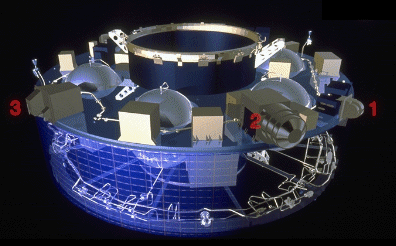
CIS consists of two detectors on each spacecraft: a Hot Ion Analyzer (HIA), which employs an electrostatic analyzer (ESA) to measure ions of all species with high angular and energy resolution; and a mass spectrometer called the COmposition and DIstribution Function (CODIF) detector. The latter instrument consists of an ESA (measuring particles in units of energy/charge) followed by a time of flight analyzer (which measures energy per mass). In combination, these can be used to separate particles into species (mass/charge).
|

Last modified: Wed Nov 21 20:37:26 PST 2001