Reference: Moore, T.E., C. R. Chappell, M. O. Chandler, S. A. Fields, C. J. Pollock, D. L. Reasoner, D. T. Young, J. L. Burch, N. Eaker, J. H. Waite, Jr., D. J. McComas, J. E. Nordholt, M. F. Thomsen, J. J. Berthelier, and R. Robson, The Thermal Ion Dynamics Experiment and Plasma Source Instrument, Space Sci. Rev., 1995.
TOF Detection System:
Ions passed by the mirror/RPA, and accelerated by the -12 kV potential as they pass through the Rejection/Deflection system, are incident upon an extremely thin (²1.0 µg/cm2) carbon foil suspended on an electroformed grid over an aperture measuring 10 mm x 25 mm. Each ion incident upon the foil creates one or more secondary electrons of a few eV energy, emitted from the rear of the foil as the ion passes through. In the foil, some of the ions are charge exchanged to neutrals and suffer some degree of energy loss and angular scattering, but continue generally along their trajectories toward the first stage of the STOP MCP detectors, arriving with a time delay appropriate to their mass/charge. Electrons produced by the first stage of the STOP MCPs are accelerated by the -12 kV potential onto the remainder of the MCP stack where a TOF stop pulse is generated.
The electrons produced at the START foil are accelerated by the potential distribution inside the TOF analyzer. As a result, they travel sideways out of the ion flight path and are collected at the START MCP detector, which is biased at a potential more positive than that of the START foil, after a delay that is negligible in comparison with the ion time of flight from START foil to STOP foil. Other surface potentials in the vicinity of the START foils are designed so as to insure that a large fraction of the electrons emitted by the foil are detected. Sample computed electron trajectories are illustrated in Figure 7.

Click the image for a larger version.
Figure 7. Section view of the TIDE sensor similar to that in Figure 4, but illustrating the optics of collection of electrons emitted from the START foils by the START MCP detectors.
There are seven TOF detector systems running in parallel, one for each of the polar angle apertures. The individual START and STOP MCPs are standard circular units of 25 mm o.d. and 18 mm active diameter. The MCPs have bias angles of ³5 degrees and are arranged in "Z" stacks of three individual stages per detector with pore orientations maximally out of alignment. This configuration reliably provides gain of ³107 throughout the nominal 3-year life of the POLAR spacecraft. MCP bias supplies are commandable over a range with four bits of resolution, so that the bias can be boosted in flight to maintain sufficient gain as required. Since individual MCP stacks all share the common bias, the flight stacks will be gain matched prior to installation.
The total number of MCPs is 3 per stack x 2 sets of stacks x 7 polar angle channels, or 42 per TIDE sensor. The plates have pores of 25 micrometer diameter, with plate thickness of 1.0 mm. The "Z" stacks obtain a pulse height distribution with FWHM ²60%. Plate resistance's are in the range of 100 MW per plate. Flight plates are of "imaging quality" without hot spots or noise enhancements, having passed a requirement of ²10 Hz/cm**2 at a gain of 1.5 x 10**7 at a threshold of 1 x 10⁶ electrons at the output of the "Z" stack. TIDE MCPs are handled under clean room conditions and TIDE is constructed of materials whose consistency with long MCP life has been demonstrated by means of lifetime testing. They are burned in as stacks to ³10**10 counts/cm**2 in a dedicated vacuum facility.
TOF Logic:
All MCP pulses are counted without regard for the presence of a correlated pulse in another detector. These count rates are termed "singles" rates to distinguish them from the more restricted set of correlated pulses resulting in time-of flight measurements.
In the ideal case every ion passing through the START foil creates one or more secondary electrons. These in turn are all collected and create a corresponding START pulse in the MCP. Every ion (or neutral) then proceeds from the foil to the STOP MCP and there creates a STOP pulse. (In fact, none of these events has a unity probability and the expected efficiency of the entire TOF event chain is ~ 0.25.) In addition, there are random START and STOP signals due to penetrating radiation (in space) and to noise in the individual MCPs (field emission of electrons) giving rise to random coincidences. The possible cases may be summarized at follows:
Start/Valid Stop
In this case a "start convert" pulse is generated and, at the conclusion of the process, a valid TOF value is also generated.
Start/No Stop
In this case the TOF circuit "times-out" at a predetermined maximum time (300 ns). The resulting TAC signal is not analyzed by the ADC because it contains no information and would only slow up processing. A "time-out" signal is generated for each such event.
Start/Second Start/Stop
After the first START pulse the TOF circuit ignores any further START pulses that occur before either a STOP pulse or a "time out." Subsequent START pulses which occur during the 300 ns TOF window are not processed, and this time therefore serves as a (non-paralyzable) dead time for the circuit. Recall that the chance probability of a valid second START within the time-out window is small unless the count rate is extremely high, which would not ordinarily be permitted (see below).
Stop/No Start
The logic does not respond to a STOP pulse unless a valid START pulse has occurred within the previous period. By definition a START event is required to fire the logic.
Start/Stop in Random Coincidence
Nothing can be done about this possibility and a random TOF value is recorded. However, note that truly random coincidences are scattered uniformly across the TOF spectrum and this background can, in principle, be measured and subtracted. The expected rate for random coincidences is: R12 = R1R2t where R1 and R2 are the START and STOP detector random rates, and t is the TOF dead time of 300 ns. Taking R1 ~ R2 ~ 100 s**-1 for all seven START and STOP MCPs (which would correspond to relatively high background levels) gives:
R = (10**2)(10**2)(3 x 10**-7) = 3 x 10⁻³ s**-1
Thus the random rate should be relatively low, if the MCPs can be kept to background rates ~10 cm**2 s**-1, a high upper limit except in the radiation belts. For a discussion of TIDE radiation shielding, see Moore and Young [1993]. This also means that in the presence of a high flux of ions the random coincidence rate increases because it is proportional to either of the singles rates. During testing of the flight model, pickup of system noise by the STOP preamplifiers has been a chronic problem. This problem will be addressed during refurbishment by means of modifications of the grounding arrangement. Spurious STOP rates as high as 3 kHz were observed during testing, but experience and the expression above agree that only very low random coincidence rates are produced at such levels.
Scientific Data Types:
The TIDE TOF electronics produces four types of events which are counted and accumulated separately:
- Detector pulse "singles" rates corresponding to the seven START channels and the one STOP channel.
- TOF logic "singles" rates corresponding to "Time-Out," "Start-Convert," and "Reset" events. Since all valid coincidence events result in either a "Start Convert" or a "Time-Out," the "Reset" rate is equal to the sum of their rates.
- "Direct Events" or START/STOP coincidence pairs are accumulated into an array of 256 TOF bins by 7 polar-angle sector ID bins over 3 min. without regard to energy step or spin azimuth sector.
- Coincidence pairs are also accumulated into an array of accumulators corresponding to 5 commandable TOF ranges (corresponding to the major species of interest), 32 E/Q bins, 7 polar-angle bins, and 32 spin azimuth bins.
Dead Time:
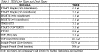
Dead time corrections are performed on the START Singles and the TOF data on-board by the TIDE DPU. The START Singles are subject to a 1.1 ms dead time when not accompanied by valid coincidence event (START CONVERT) and to an additional 2.0 ms dead time when accompanied by START CONVERT. Data associated with TOF events are always subject to the full 3.1 ms dead time. The relevant dead times associated with various TIDE signals are given in Table 3.
Click image for larger version.
Table 3. TIDE Live Times and Dead Times
Back to TIDE Instrument Description
|