Reference: Moore, T.E., C. R. Chappell, M. O. Chandler, S. A. Fields, C. J. Pollock, D. L. Reasoner, D. T. Young, J. L. Burch, N. Eaker, J. H. Waite, Jr., D. J. McComas, J. E. Nordholt, M. F. Thomsen, J. J. Berthelier, and R. Robson, The Thermal Ion Dynamics Experiment and Plasma Source Instrument, Space Sci. Rev., 1995.
Summary:
The Thermal Ion Dynamics Experiment/Plasma Source Instrument (TIDE/PSI) has been developed in response to the requirements of the ISTP Program for a three dimensional plasma composition instrument capable of tracking the circulation of low-energy plasma throughout the polar magnetosphere, and investigating its participation in the formation of the diamagnetic hot plasma sheet and ring current plasma populations.
TIDE provides the sensitivity (seven channels at ~0.6 cm2 each) and temporal resolution required for this purpose, as well as the capability of an electronically-controlled aperture to prevent overexposure in denser environments. Analogous to other optical systems, reduction of the TIDE aperture results in enhanced resolution of angular and energy features in the observed ion distribution, albeit at reduced counting rate and therefore reduced temporal resolution. TIDE automatically adjusts its sensitivity to varying conditions, and it emphasizes temporal or angular resolution when appropriate.
With nearly a full three dimensional view of the sky each spin, TIDE's seven angular sectors/channels monitor all mass species simultaneously, eliminating the need for any sweeps except energy, and producing a 7-kByte image of the distribution function for each of five ion species once each 6 sec spin. The TIDE DPU computes simple moments for each species every spin, and monitors the record for notable variability. It routinely encodes measurements in a floating point form, collapses angular oversampling out of the data array, and performs lossless compression to optimize telemetry use. When variability of the moments indicates the need for full time resolution, it truncates the data so as to obtain single spin temporal resolution for the most important ion species. Enhanced spin angular resolution may be obtained when fluxes are sufficient to permit "stopping" down the aperture, at a corresponding loss of temporal resolution.
PSI produces a low-energy plasma local to the POLAR spacecraft which provides the ion current required to balance the photoelectron current, along with a low temperature electron population, thus regulating the spacecraft potential a few tenths of a volt positive.
Thus TIDE/PSI will permit investigation of the extent to which ionospheric and low energy magnetosheath ions are lost to the solar wind or recirculated within the distant magnetotail neutral sheet. For those ions which are recirculated and energized, it will be possible to investigate (through collaboration with the TIMAS and other investigations) the mass-dependent degree of energization achieved as the plasma flows antisunward on merged flux tubes through the lobes and into the plasma sheet. TIDE/PSI will provide the fundamental information necessary to investigate the ionosphere and the magnetosheath as sources of low-energy plasma to the plasma sheet and ring current.
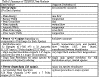
Click image for larger version.
Table 5.Summary of TIDE/PSI Data Products
Back to TIDE Instrument Description
|