Reference: Moore, T.E., C. R. Chappell, M. O. Chandler, S. A. Fields, C. J. Pollock, D. L. Reasoner, D. T. Young, J. L. Burch, N. Eaker, J. H. Waite, Jr., D. J. McComas, J. E. Nordholt, M. F. Thomsen, J. J. Berthelier, and R. Robson, The Thermal Ion Dynamics Experiment and Plasma Source Instrument, Space Sci. Rev., 1995.
TIDE Specifications:
The fundamental design goal for TIDE has been to achieve a geometric factor much greater than that of previous instruments, opening up an unknown regime to discovery. An extremely large dynamic range of low-energy plasma fluxes is seen by a spacecraft in the course of an orbit from the ionosphere to the polar regions at several RE altitude. DE 1/RIMS, for example, routinely experienced fluxes which ranged from well above detector saturation levels to low levels requiring long accumulations, to levels so low they could not be measured above an extremely low detector noise rate (²1 Hz). Therefore, though POLAR will not travel as close to the Earth as DE 1 did, extension of dynamic range is required in order to adequately sample both the lowest and highest density/flux regions.
TIDE has also been designed to provide low- energy measurements which are differential in energy and direction as well as mass, with range and resolution adequate for the full characterization of velocity distribution features known to exist in the low-energy plasma populations. These features include polar wind flows of very high Mach number, which were unresolved in angle or energy by DE 1/RIMS. Other features, that appeared to DE 1 as crosswinds, could be lost between the RIMS fields of view due to insufficient angular coverage. Another important type of feature is the angle-dependent energy distribution of transversely accelerated ion distributions or ion conics, which required differentiation of the RIMS Retarding Potential Analyzer (RPA) curves with a resulting loss of signal/noise ratio.
Time resolution is of primary importance on a rapidly moving spacecraft when it passes through localized structures. The larger the number of variables scanned during instrument operations, the more difficult it becomes to achieve adequate temporal resolution of phenomena. This problem is all the more serious for mass spectrometers. Prototypes of TIDE used an electrostatic deflection system for angular scanning with a single mass analyzer section. It has become apparent during sounding rocket flights of such instruments (e.g., the SuperThermal Ion Composition Spectrometer or STICS) that this provides an imperfect solution to the problem of angular range, placing extreme requirements on the stepping power supplies which sweep the angle, energy, and mass selection. TIDE solves this problem by using multiple independent angular detection channels, each equipped with an independent time-of-flight (TOF) mass analyzer section, which monitors all mass species simultaneously. The only variable which must be swept, using stepping power supplies, is the ion energy. This can be accomplished in a time small compared with the POLAR spin period, so that single spin time resolution of the multi-species 3D distribution function is achieved.
Table 1 provides a summary of the technical specifications for TIDE which details the resolution and sensitivity of the instrument. TIDE's geometric factor is nearly an order of magnitude larger than that of DE/RIMS on a "per channel" basis. Moreover, TIDE has seven simultaneously-active contiguous channels, compared with three separated channels for RIMS. It can be argued that a more meaningful figure of merit for the sensitivity of an instrument than the geometric factor is the "effective area" of the aperture. This measure does not award credit for large solid angle or energy apertures, which degrade the resolution of the instrument. By this measure, each TIDE aperture is nearly a full two orders of magnitude larger than a RIMS aperture (and outnumber them 7:3), having an effective area in excess of 1 cm2. Such a large effective area allows TIDE to be designed for improved energy and angular resolution, while maintaining very high sensitivity.
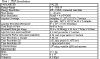
Table 1. TIDE Specifications
Click the image for a larger version.
Back to TIDE Instrument Description
|