Reference: Moore, T.E., C. R. Chappell, M. O. Chandler, S. A. Fields, C. J. Pollock, D. L. Reasoner, D. T. Young, J. L. Burch, N. Eaker, J. H. Waite, Jr., D. J. McComas, J. E. Nordholt, M. F. Thomsen, J. J. Berthelier, and R. Robson, The Thermal Ion Dynamics Experiment and Plasma Source Instrument, Space Sci. Rev., 1995.
PSI Source System:
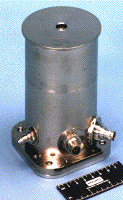
The hollow-cathode source is illustrated schematically in Figure 9, and photographically in Plate 2. The cathode is a porous-tungsten material impregnated with barium aluminate, a material with a low work function. Initially the cathode is heated with an external filament to begin thermionic emission. Xenon gas flowing through the hollow cathode is initially ionized by the thermionic electrons accelerated by the potential on the keeper electrode. The axial magnetic field serves to confine the electrons and increase the probability of an ionizing collision, thereby minimizing the rate of gas flow required to obtain a given ion current. Once the keeper discharge is initiated, a fraction of the positive ions is accelerated back to the cathode and produce local impact heating. After an initial heating time, the filament can be turned off and the thermionic emission is maintained without the penalty of heater power.

Click image for larger version.
Figure 9. Schematic illustration of PSI source, illustrating the roles of the several PSI power supplies in providing plasma emission and bias control.
Click image for larger version.
Plate 2. Photograph of the PSI source assembly. Plasma is emitted from the aperture at the end of the cylindrical package.
The keeper electrode and anode are biased +18 and +25 volts, respectively, relative to the cathode. The neutral xenon gas flows throughout the entire region between the gas inlet and the outer shield exit. The potential structure accelerates electrons toward the anode, and production of plasma therefore occurs throughout the region. The distribution of plasma generation can be controlled to some extent by the magnitudes of the keeper and discharge voltages. A plume of low-energy plasma therefore exits the anode orifice, and the current can be "fine-tuned" by adjusting the magnitude and polarity of the bias supply. This supply biases the entire plasma source relative to spacecraft frame ground, and an electrometer measures the net current produced by the source.
Back to TIDE Instrument Description
|