Reference: Moore, T.E., C. R. Chappell, M. O. Chandler, S. A. Fields, C. J. Pollock, D. L. Reasoner, D. T. Young, J. L. Burch, N. Eaker, J. H. Waite, Jr., D. J. McComas, J. E. Nordholt, M. F. Thomsen, J. J. Berthelier, and R. Robson, The Thermal Ion Dynamics Experiment and Plasma Source Instrument, Space Sci. Rev., 1995.
Science Operations:
The various data products generated by TIDE/PSI are summarized in Table 5. TIDE Science Operations will consist primarily of the proper selection of modes controlling the properties of these data products. To support the ammassment of a large synoptic data set, TIDE is designed insofar as is possible to make observations in a constant and repetitive fashion, with a minimum of mode switching.
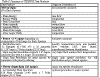
Click image for larger version.
Table 5.Summary of TIDE/PSI Data Products
The "standard" operating mode will provide complete distribution function reports for five species, with oversampling near the spin axes removed by collapse, at intervals of 2-4 spins (12-24 sec.). In addition, crude moments and comprehensive mass spectra will be delivered at the intervals shown in the table. TIDE will remain in this mode during the bulk of its operations. Two exceptions are admitted:
High Time Resolution: When the selected criteria are met, which may include the presence of "burst" data mode flags on the interfaces to EFI and HYDRA or the identification of high variability in the TIDE moment data, TIDE will switch automatically to a high time resolution mode, in which maximum array collapse is implemented and as much data as possible is sent every spin. Generally, this will include reduced resolution reports for each of a minimum of three species. Of course, TIDE can be left in this mode continuously, if that proves to be desireable.
High Angular Resolution: When experience suggests that features are present in the data that are (a) unresolved in azimuth angle, (b) present at predictable locations and/or times, (c) persistent for multiple spins, and (d) have sufficient ion flux, TIDE can be programmed to sacrifice temporal resolution in favor of more detailed angular sampling. The angular sampling resolution can be increased from 32 bins (11.25 degrees) to either 64 or 128 bins. This feature is expected to find its principle application in accurate measurement of cold polar wind temperature. Because there may be other unanticipated benefits as well, this mode will be exercised regularly, but on a low duty cycle.
Back to TIDE Instrument Description
|