Reference: Moore, T.E., C. R. Chappell, M. O. Chandler, S. A. Fields, C. J. Pollock, D. L. Reasoner, D. T. Young, J. L. Burch, N. Eaker, J. H. Waite, Jr., D. J. McComas, J. E. Nordholt, M. F. Thomsen, J. J. Berthelier, and R. Robson, The Thermal Ion Dynamics Experiment and Plasma Source Instrument, Space Sci. Rev., 1995.
Appendix 2: Electronics Description:

Click image for larger version.
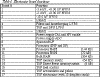
Figure 5 is a simplified schematic diagram of the major electronic components of TIDE. The actual TIDE operational power is 9.1 W, well under the allocation of 10.0 W. The major TIDE electronics subsystems are: spacecraft power and data interfaces; low voltage power supplies and filters (±3, ±5, ±10, ±15, and 28V); high voltage power supplies (0 to +300V RPA, 0 to +300V Mirror, 0 to -2.4 kV, 0 to -3.6 kV, 0 to -15 kV), TOF electronics, TOF-ADC interface, DPU and associated memory, and Ground Support Equipment (GSE). The TIDE electronics are built in a modular fashion such that, to the greatest extent possible, similar groups of electrical functions are on the same electronics board, as briefly summarized in Table 6.
Click image for larger version.
Table 6. Electronics board functions
Time-Of-Flight Electronics:
Seven START and seven STOP signal lines provide inputs to the TOF electronics. The seven STOP signals are summed into a single STOP signal, effectively a logical OR operation. Amplitude discrimination of MCP pulses occurs on each START and the summed STOP signals, resulting in eight pulse trains which are accumulated regardless of time correlation to form START and STOP ÒsinglesÓ rates. The seven STARTS are summed (ORÕd) after discrimination.
Correlated START/STOP pulse pairs trigger the capture of output from a single time-to-amplitude converter (TAC) circuit, which, owing to the logical OR operations, can service the seven TIDE polar-angle sectors. Figure 18 shows a simplified schematic diagram of the TIDE TOF logic. The mass identification process consists of converting a time interval between received START and STOP pulses into a digital word and combining this information with the encoded polar angle of arrival (START sector ID). Such events are accumulated in memory addresses corresponding to the TOF, the START sector ID, the current energy step, and current spin sector. Additional information is obtained from the singles rates to monitor total ion flux (independent of mass/q) and TOF processing efficiency. Error and reset logic are used to prevent data collisions and corruption during the processing interval.

Click image for larger version.
Figure 18. TOF electronics block diagrams illustrating the relationships among the principal components: the START and STOP preamplifier-discriminators, the TAC, and the logic module.
TOF Test Pulser:
A pulser circuit is included in the TOF electronics section to directly stimulate the START and STOP preamplifiers in all seven sectors. Pulses from the preamplifiers are used to test the entire signal chain. The pulser generates a range of selected delays between START and STOP pulses in order to test TOF circuitry. These TOF data are fed into the DPU memory and are used to test DPU routines.
ADC for TAC Signal:
The ADC output determines the bin location for sorting TOF according to time channels prior to count rate transmission. For TIDE this is 8 bits or 256 channels. The number of mass peaks selected from the TOF channels is limited by telemetry to five M/Q peaks.
High Voltage Power Supplies:
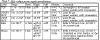
Table 7 summarizes the TIDE high voltage power supplies and the requirements for these supplies, which are further discussed in the subsections below.
a larger version is available
Click image for larger version.
Table 7. High voltage power supply specifications
Time-of-Flight HVPS:
Power to the STOP MCPs mounted at the TOF HV is provided by a direct tap on the -15.0 kV supply. Although this requires an extra HV wire and feedthroughs to the sensor, it lowers total power requirements by eliminating the low ohmic divider. The remainder of the HV values needed for the TOF are provided by a high ohmic (>1010 W) divider mounted inside the sensor housing. The supply should be commanded to high voltage in a number of steps in order to allow the sensor to condition itself to the applied voltage, and also to provide a lower voltage to operate at in case we cannot achieve the -15 kV maximum. As is the case for other HV supplies on TIDE there are 8 bits of usable control available in the DAC and buffer registers so that a resolution of 58.6 V can be used to adjust the TOF high voltage. The -15.0 kV supply monitor provides an analog voltage scaled at 0 to 4 V for 0 to -15.0 kV (5000:1 divider). The monitor voltage is digitized to 8 bits of accuracy. The time sequence for raising the TOF HV to -15.0 kV consists of two stages. First, the instrument must be exposed to high vacuum for a duration sufficient to insure thorough outgassing of the entire instrument. In practice, we have had good success by turning on TOF high voltage only after the instrument has been at a chamber pressure of ²1 x 10⁻⁶ T for a minimum of 24 hours.
Microchannel Plate HVPS:
The START and STOP MCPs are operated from separate HVPS for reliability and because each stack must run at a different potential in any case. In order to avoid individual high voltage bias supplies for each sector while maintaining good uniformity from sector to sector, the MCPs have been specified to have consistent impedances from plate to plate and stack to stack (±10%). The resistance per plate is approximately: R ~100 megaohm. Thus a single START stack (3 plates) is ~300 megaohm, and the STOP stack (2 plates) is ~200 megaohm. Since a stack of 3 START MCP plates has a resistance of ~300 megaohm, a full set of 7 in parallel has a total resistance of R ~43 megaohn and at -3.6 kV maximum voltage the total strip current is ~85 microamps. The stack of 2 STOP MCPs has a resistance of 200 megaohm, so that a full set of 7 in parallel gives R ~ 29 megaohm. At -2.4 kV the total strip current is ~85 microamps.
MCP Z stacks are chosen for consistent multiplication gains, by dividing into START, STOP, and SPARE groups. During calibration, the optimum MCP bias operating points for START and STOP detectors is determined by varying the biases and observing the integral rate of discriminated pulses.
Retarding Potential Analyzer Supply:
The voltage varies from 0.00 V to 300.0 volts with 12-bit resolution. This corresponds to a voltage resolution deltaV = 0.0732 v. The shortest sample period is 5.86 ms and settling time is <10% of this period. The RPA supply output monitor provides an analog signal scaled at 0 to 4.0 V for 0 to 300 V input. This is monitored in TM to 8 bits of accuracy.
Mirror Supply:
The voltage varies from 0.0 V to 300 V, but is controlled as a fraction of the RPA potential ranging from zero to unity with 8 bits of resolution. Thus the default is for the Mirror to track the RPA potential in a fixed ratio during a sweep. However the ratio is commandable on each step of the energy sweep, and is the parameter which controls the overall instrument sensitivity. The mirror voltage is the specified fraction of the RPA voltage to an accuracy equal to that of the 8-bit command resolution (0.4%) or 40 mV, whichever is greater.
Data Processing Unit:
The following describes the general functions of the DPU. Figure 19 shows a highly schematic overview of the TIDE DPU and control system.

Click image for larger version.
Figure 19. TIDE IMP/DP schematic block diagram.
Microprocessors:
The data processor (DP) is a Sandia SA3300 microprocessor with a 16-bit external and 32-bit internal bus, running at 8 MHz. This processor is used to execute computation intensive tasks, primarily the calculation of moments from the spin by spin data arrays. Hardware capability is provided to interrupt the processor on critical events such as the spin pulse, minor frame, etc.
The instrument mode processor (IMP) is also a Sandia SA3300 microprocessor running at 5 MHz. It is used to perform housekeeping tasks such as telemetry formatting, HV control and associated TIDE control functions. In addition, the IMP performs bulk data compression when that function is enabled. Interrupt capability is also be provided for events such as minor frame sync, command, telemetry, etc.
Memory configuration is as summarized in Table 6. The IMP and the DP have shared access to 144 kB of RAM and 72 KB of PROM. The processors obtain their data through data acquisition memories which are incremented independently of the processors by the load control circuit. These amount to 8 kB and 64 kB for the IMP and DP, respectively. In addition, the DP has a bulk RAM allocation of 384 kB for intensive calculation space.
TOF Interface:
The TOF interface requires digitizing the TOF signal by a flash ADC to 8-bits resolution. The 8 bits are then filtered through a mass/charge lookup table, which is RAM based and can be updated in flight, that generates a 3-bit mass address. Along with a 3-bit sector identification, these data are binned according to azimuth and energy. These data are acquired in a 128 kilobyte memory system over a 6-sec spin period. There are two such memory systems so that at a spin boundary the memory systems are swapped. This allows the data processor access to the previous spin of data while acquisition is occurring in the other memory system.
The ADC digitizes the analog TOF signal to an 8-bit channel number, which determines the bin location for sorting events, both in Direct Event memory (full 8-bit resolution) or in the main Angle-Energy array memory (3-bit resolution). The ADC input must have an input impedance sufficiently high that it is adequately driven by the TOF output driver.
16-bit counters are provided to accumulate all singles rate outputs from the TOF electronics, sorted according to azimuth angle and energy step. These data are acquired in the same memory system as described above. The 8-bit output of the TOF ADC along with the 3-bit sector ID is used in a separate (direct event) data acquisition system that bins the 11-bit data over a 3-minute accumulation time. Upon an ADC start pulse, each direct event is binned during a dead time period which exceeds that for the binning of ordinary TOF events into mass bins, as indicated in Table 3. To accommodate the longer accumulations, 32 bit accumulation words are used.
Memory Sub-System:
Hardware capabilities are provided to the data processor for copying memory contents from the data acquisition memory to general purpose memory. In addition to the copy function, a hardware lookup table function is supplied to encode the data in a compact floating point representation, as further described in the section below on Flight Software. Finally, a hardware block add/subtract function is provided. All of these hardware functions are under software control and are intended to reduce software overhead of the data processor.
High Voltage Power Supply Interface:
Logic is provided to turn on the HV power supplies in three stages. Spacecraft pulse commands are used to arm the supplies for microprocessor commanding. The three pulse commands arm the RPA/MIR, MCP (START and STOP) and TOF high voltage supplies. A fourth pulse command is provided to act as a "breaker" switch for all HV supplies. Once the supplies have been armed, (major) commands can then be issued to individually enable commanding any of the five HV supplies. Finally, the appropriate control levels, which are generated by digital-to-analog converters (DACs), can be commanded (minor commands) to complete the HV turn-on. Upon DPU power up the control levels reset to zero. Control of the RPA and MIRROR HV control levels is done via sweep tables which are either resident in ROM or built up in RAM by (minor command) upload and then executed by minor command. The stepping of the supplies according to the tables is synchronized to the sample period. The RPA and MIRROR HV have 12-bit and 8-bit control voltage resolution, respectively. The Start MCP, Stop MCP, and TOF HV have 8-bit control voltage resolution.
Spacecraft Interface:
All of the spacecraft interfaces described are in accordance the GE General Instrument Interface Specification (GIIS) document number 3282065. The interface consists of a 40-bit serial command channel, together with three 8-bit parallel/serial registers that are provided for the s/c to acquire telemetry data on greater than 1 millisecond centers per minor frame. MAGAZ and MAGEL signals are received from the s/c and utilized in computations. The spin phase clock and pulse are used to synchronize the operations of the instrument to the s/c spin. Analog housekeeping signals for ascertaining the health and safety of the instrument are digitized using a general purpose analog to digital converter. A PSI "Squirt" signal is provided the Electric Field and Plasma Wave Instruments. Signal interfaces are provided to the HYDRA (energetic plasma) and EFI (Electric Field Instrument) investigations in order to determine when they enter a "burst memory" state indicative of rapid temporal fluctuations in the local plasma or fields.
GSE:
The GSE is based on a functional emulation approach. It contains separate PC computers to simulate the POLAR spacecraft and the controlling ground station. It also contains a Sun workstation to serve as an emulator for the Remote Data Analysis Facility, where the full data displays are developed. This is a complex system, but the approach is designed to test all phases of the data link between TIDE and the investigators. All power supply, pulser calibration, and similar functions are computer controlled by the GSE computer. There is never a need for persons conducting a test to "turn a knob"--the setting of which then has to be written down or otherwise entered manually into the test data record.
PSI Electronics:
The PSI electronics system is illustrated schematically in Figure 20. It contains the discharge, keeper, heater, and bias supplies for operation of the source, a bipolar log-electrometer to measure the net emission current from the source (this constitutes the return current from the satellite), valve drivers, analog telemetry signal conditioning, and the TIDE interface.

Click image for larger version.
Figure 20. PSI Electronics block diagram.
The remaining components of the PSI are the various control electronics and interface circuitry necessary for interfacing with the TIDE power, data, and command system. The primary controls are the startup heater, the keeper potential, anode potential, and the bias supply. The primary data reported to the data stream are the emission current and power supply monitors, which are reported in the TIDE data stream.
The TIDE instrument controls all phases of PSI operations. The application of 28-V power and a simple command is all that is required to start the plasma source. A maximum of 20 other commands are required to set the level of the bias supply and make minor adjustments to the operation of the source (including control of all power supplies). Approximately 20 telemetry words are used to monitor PSI operations.
Back to TIDE Instrument Description
|